OLED vs QLED vs Mini LED: Which TV Screen Should You Choose in 2026?
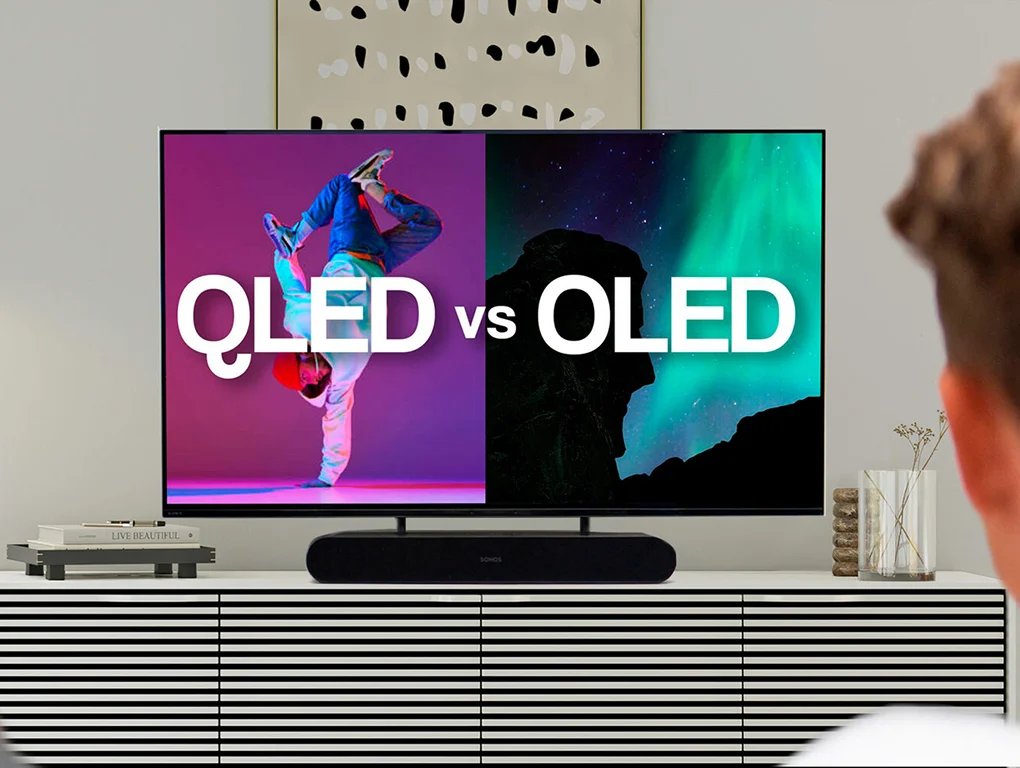
QLED (left) excels at vivid, bright colour; OLED (right) delivers perfect blacks and infinite contrast — different strengths for different rooms.
Walk into any TV section — physical or online — and you'll be confronted immediately with a wall of acronyms: OLED, QLED, QD-OLED, Neo QLED, Mini LED, Tandem OLED, MLA. Each manufacturer uses slightly different terminology, and marketing materials are rarely transparent about what the differences actually mean for picture quality in a real living room.
This article cuts through the jargon. We focus on the three technologies that matter most for the majority of buyers at Smart Home Sounds: OLED, QLED and Mini LED — covering what each does well, where each falls short, and which one makes sense depending on how your room is set up and what you watch most.
Contents
What is QLED?
QLED is at its core an LCD panel with a quantum dot enhancement layer. Rather than relying on a conventional white LED backlight shining through colour filters, a QLED TV uses a blue LED backlight that passes through a film of microscopic quantum dot particles. These particles convert the blue light into more precise red and green wavelengths, producing a wider colour gamut and more accurate colour at higher brightness levels.
The result is a panel that can display vivid, punchy colours and reach high peak brightness figures — useful in rooms with significant natural light, and for HDR content where the difference between a good and great display is often how bright the highlights can get.
What QLED cannot do is control light at the pixel level. It still relies on a backlight, which means very dark parts of the image cannot be truly black — the backlight is always on to some degree. In dark scenes with bright objects, this can produce a "blooming" effect where bright objects create a faint halo against dark backgrounds.
QLED Strengths
- High peak brightness — strong in bright rooms
- Excellent colour volume and saturation
- Strong HDR performance with vivid highlights
- More affordable at large screen sizes
QLED Limitations
- Cannot achieve true blacks
- Blooming visible in high-contrast scenes
- Viewing angles narrower than OLED
What is Mini LED (Neo QLED)?
Mini LED is the most significant upgrade to LCD television technology in the past decade. Instead of using a small number of large LED backlighting zones, Mini LED TVs pack thousands of significantly smaller LEDs behind the screen. Samsung's Neo QLED range is the most prominent example, though LG, Hisense and others use similar approaches under different names.
More LEDs mean more localised dimming zones — and more zones mean the TV can more precisely dim or brighten specific areas of the image independently. A dark night sky with a bright moon, for example, can have the sky genuinely dark while the moon appears bright — something difficult for standard QLED to achieve without blooming.
The result bridges the gap between QLED and OLED meaningfully. Mini LED TVs now deliver contrast performance that would have seemed impossible from an LCD panel five years ago, while retaining the brightness advantages that LCD has always held over OLED.
Mini LED Strengths
- Significantly better contrast than standard QLED
- Outstanding peak brightness — rivalling any TV technology
- Excellent for bright rooms and sports
- Strong at large screen sizes (75"+) for the money
Mini LED Limitations
- Still backlit — cannot match OLED's pixel-level control
- Residual blooming in extreme high-contrast scenes
- Premium models expensive
What is OLED?
OLED remains the reference standard for picture quality precision, and the reason is elegantly simple: each individual pixel is its own light source. When a pixel needs to show black, it switches off entirely. There is no backlight bleeding through, no blooming, no dimming zones to manage. The contrast ratio is, in the truest technical sense, infinite — because true black involves no light at all.
This gives OLED a cinematic quality that even the best Mini LED TVs cannot fully replicate. Shadow detail, the gradation from dark grey to deep black, the sense of depth in a night scene — these are areas where OLED retains a natural advantage that pure engineering makes difficult to overcome through a backlit approach.
The traditional criticism of OLED — lower peak brightness compared to LCD — has been addressed substantially in recent generations. Modern OLED technologies including MLA (Micro Lens Array), QD-OLED and the new Primary RGB Tandem OLED panels have dramatically increased peak brightness, closing the gap with Mini LED significantly.
OLED Strengths
- True black — perfect pixel-level contrast
- Near-instant response times — ideal for gaming
- Wide viewing angles
- More versatile brightness than older OLED generations
OLED Limitations
- Smaller risk of image retention in extreme static use
- More expensive at equivalent sizes vs QLED
- Very bright rooms may favour Mini LED's sustained brightness
Head-to-head: which technology wins where?
| Category | QLED | Mini LED | OLED | Winner |
|---|---|---|---|---|
| Cinema & dark scenes | Fair | Good | Reference | OLED |
| Bright room viewing | Good | Excellent | Good (flagship) | Mini LED |
| Gaming (response) | Good | Good | Excellent | OLED |
| Sports | Good | Excellent | Good | Mini LED |
| Large screen value | Excellent | Good | Fair | QLED |
| Colour accuracy | Good | Very Good | Excellent | OLED |
| Overall versatility | Good | Very Good | Excellent | OLED (flagship) |
What's new for OLED in 2026: Tandem OLED explained
The most significant development in TV technology for 2026 is Primary RGB Tandem OLED — also described as "four-stack OLED." LG Display introduced this panel in their flagship G5 model, and it represents a fundamental redesign of how OLED panels generate light.
Traditional WOLED panels use a white OLED emitter combined with colour filters. Tandem OLED instead stacks four separate OLED emission layers — two blue layers with dedicated red and green layers — to produce colour more directly and efficiently. The practical effect is significantly higher peak brightness (putting flagship OLED much closer to Mini LED brightness levels) alongside improved colour volume and greater panel efficiency. For viewers, this means the trade-off between OLED's perfect blacks and the brightness limitations of earlier generations is substantially diminished.
QD-OLED (as seen in Samsung and Sony flagship models) remains highly competitive, using quantum dot colour conversion on top of a blue OLED emitter for vivid, punchy colours with excellent brightness. Both technologies represent meaningful step-changes from the OLED of three or four years ago.
Which should you buy? Three questions to answer first
1. How bright is your room during your main viewing hours?
If your living room receives significant natural light — particularly if it's south-facing or lacks heavy curtains — Mini LED's sustained full-screen brightness gives it a practical advantage during the day. Flagship OLED panels have closed the gap substantially, but a mid-range Mini LED will still outperform a mid-range OLED in a genuinely bright room.
2. What do you watch most?
Films in controlled lighting, gaming, and cinematic TV — OLED. Live sport, daytime viewing, HDR documentary content — Mini LED. General everyday use on a budget at large sizes — QLED.
3. What's your budget at your chosen screen size?
QLED remains the most affordable route to large screen sizes (75" and above). OLED pricing has become more competitive in recent years — 42" models now start below £1,000 — but at equivalent sizes, a QLED or Mini LED will usually offer more screen for the money.
There are now genuinely outstanding TVs on both sides of the OLED vs. QLED debate. If you're still uncertain after reading this, the Smart Home Sounds team offers free expert advice before you buy — available via phone, live chat or in-store.